
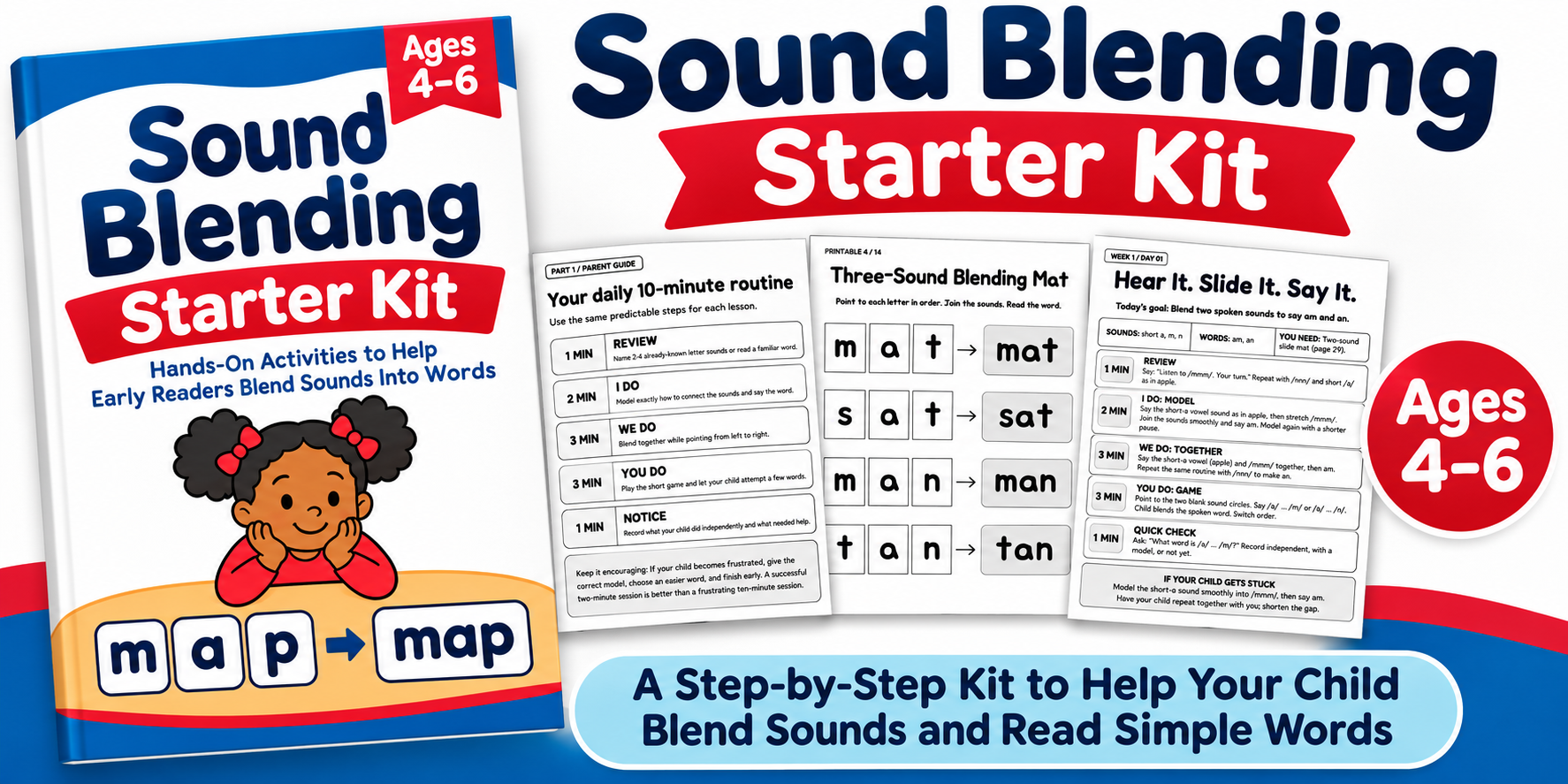
Your Child Knows Their Letter Sounds… But Still Can't Read the Word?
Help your child turn individual sounds into real words with 20 simple, 10-minute lessons.
Created by a teacher with 20 years of experience, this step-by-step kit shows you exactly what to say, what to practice, and how to help when your child gets stuck.
Get the Sound Blending Starter Kit for $17
Start Helping Your Child Blend Words This Week
Get the complete 20-lesson Sound Blending Starter Kit for $17 and start with Day 1 tonight.
Your child knows the letters. They can even tell you the sounds. But put the word am in front of them and they freeze, guess from the first letter, or say each sound separately, /a/ ... /m/, and never get to the word.
If that sounds like your kitchen table, nothing is wrong with you or your child. They're missing one specific skill, and it's the bridge between knowing sounds and actually reading: blending.
Blending means pushing separate sounds together into a word. In my years in K–3 classrooms, I've seen that it rarely clicks on its own. It has to be taught directly, in small steps, with short and frequent practice.
Most parents are left with a stack of flashcards and a lot of guessing. You don't need more activities. You need a plan that tells you exactly what to say and do today.
Meet the Sound Blending Starter Kit
The Sound Blending Starter Kit is a 54-page printable program that teaches your child to blend sounds into words in 20 short lessons. You open one card a day, read the script, and teach. No planning, no hunting for activities.
Every lesson follows the same simple pattern: I do (you show it), We do (you try it together), You do (your child does it alone). The layout never changes, so your child knows what to expect and you never wonder what comes next.
The kit starts with listening, no letters needed. A printed word only appears after every letter in it has been taught, so your child is never asked to read a sound they haven't learned.
It's built for you, too. You get a guide to saying each sound correctly, a no-pressure starting check, and troubleshooting pages for the days it isn't clicking.
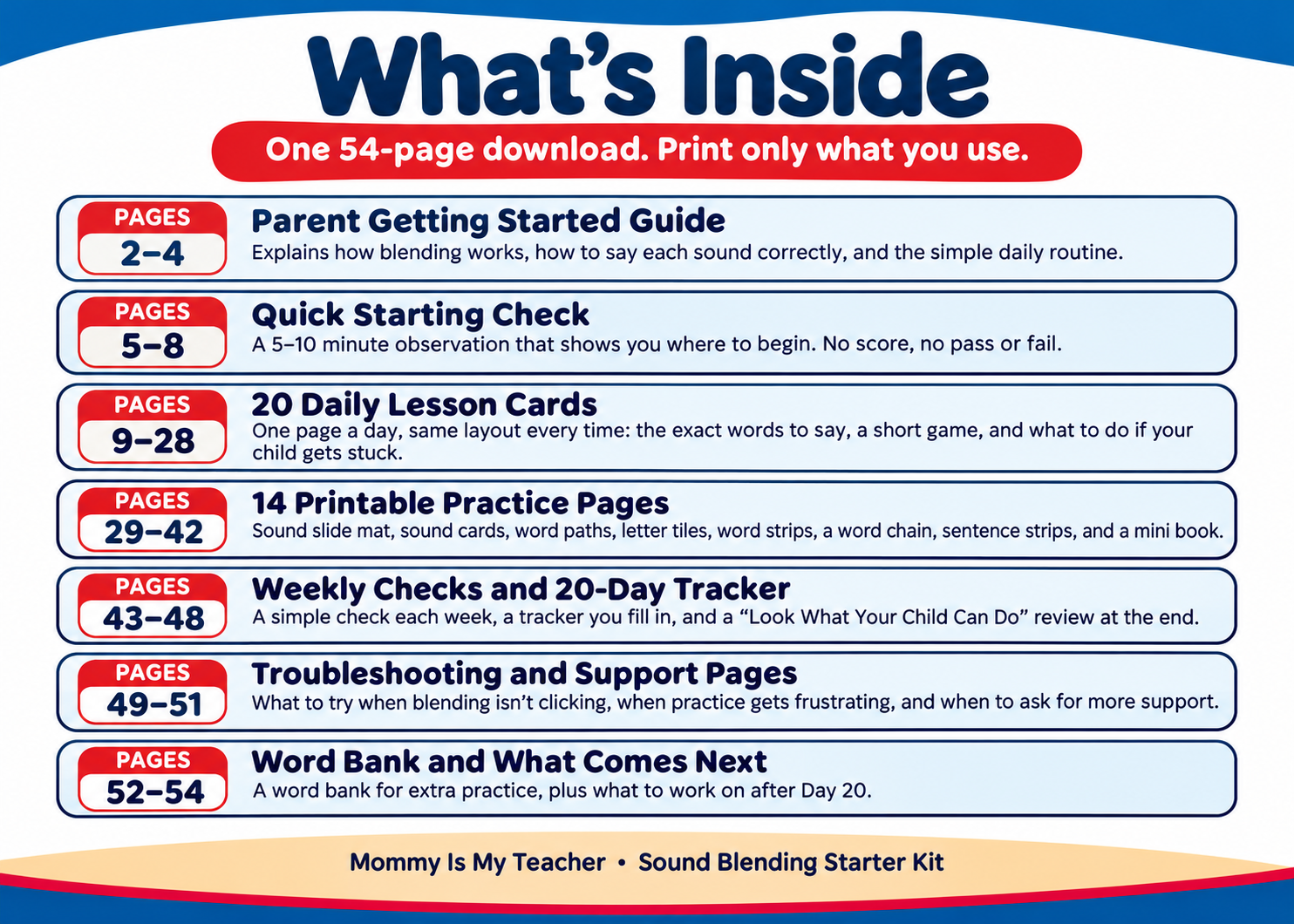
What's inside
Everything you need to teach blending is in one 54-page download, and you print only what you use.
How it works: 10 minutes a day for 4 weeks
Each day is one lesson card, and every card runs the same five steps:
Review (1 minute)
I do: model (2 minutes)
We do: together (3 minutes)
You do: game (3 minutes)
Quick check (1 minute)
Every card also tells you what to try if your child gets stuck, and gives you one thing to do before tomorrow.
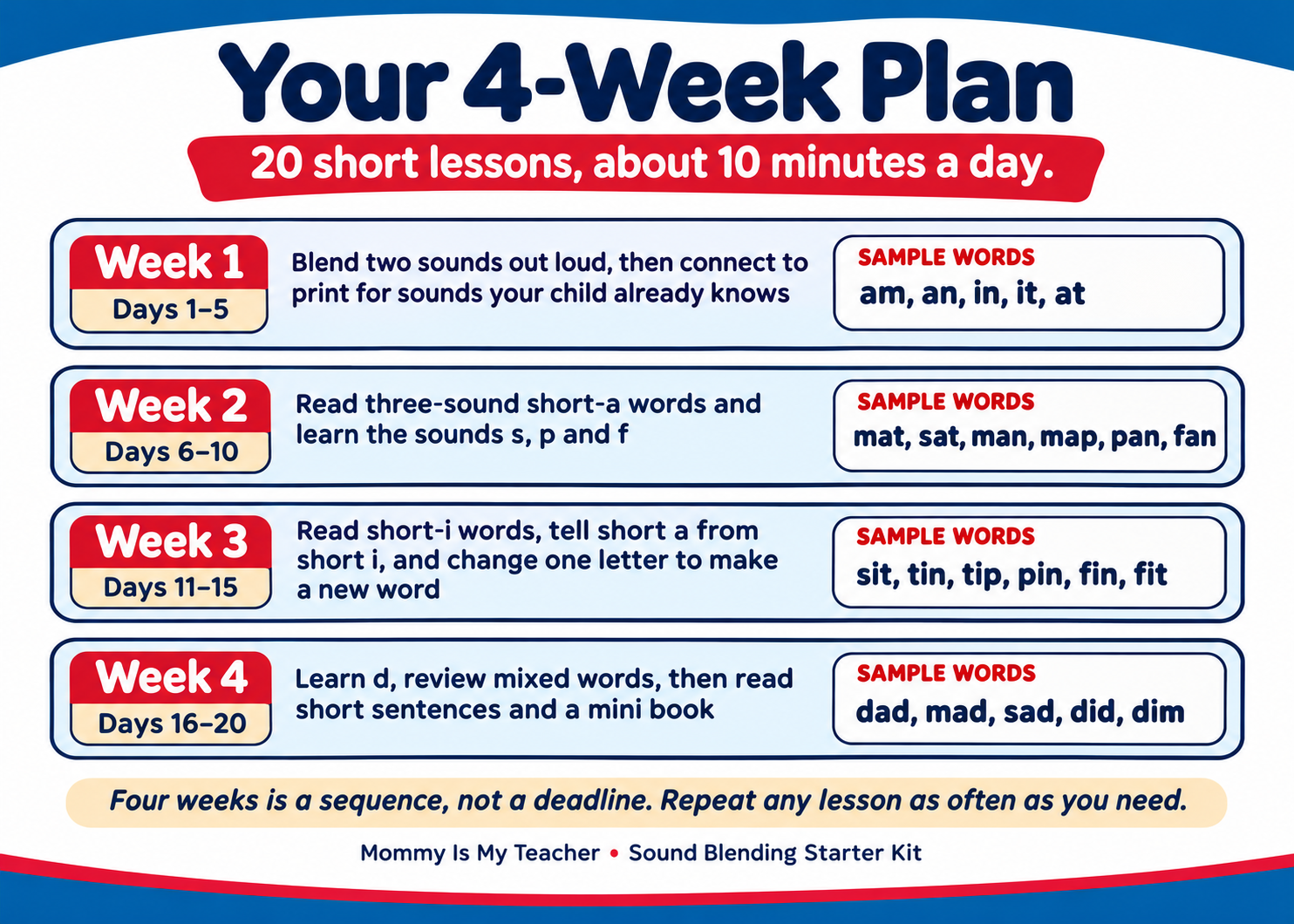
Four weeks is a sequence, not a deadline. If a lesson needs a second or third day, repeat it. Your child sets the pace.
Is this kit right for your child?
This kit is for you if:
Your child is 4–6, or an older beginning reader who is still learning to blend.
Your child knows (or you're willing to review) the sounds for a, m, n, i and t.
Your child can say the sounds but gets stuck turning them into words.
You want exact words to say, not another pile of activities.
You have about 10 minutes a day.
What this kit is not:
A full reading curriculum. It teaches one skill, blending, using short-a and short-i words.
A test or a diagnosis. The Quick Starting Check is an observation to help you choose where to start. It does not assess a reading disability.
A replacement for individualized support. If your child is struggling a lot, the kit shows you when and how to ask for more help.
Meet your teacher
Hi, I'm Dr. Haji. I've spent 18 years teaching K–3, and I hold an EdD in Educational Technology. I also homeschool my own child, so I know what it feels like to be the parent holding the flashcards and wondering what to do next.
My work sits where the science of reading meets real family life: explicit, step by step, and short enough to do every day. I made this kit to be the plan I'd hand a parent who asked me, "My child knows their sounds. Now what?"
Get the Sound Blending Starter Kit
$17, one-time payment. Instant download, and you print only what you need.
You get the Parent Getting Started Guide, the Quick Starting Check, 20 Daily Lesson Cards, 14 printable practice pages, weekly checks, a 20-day tracker, three troubleshooting pages, a word bank, and a What Comes Next page. That is 54 pages, ready to use tonight.
That's less than a lunch out, for a plan you can follow every day for four weeks.
Button: Get the Starter Kit for $17
What if my child doesn't know all the letter sounds yet?
Your child should know a, m, n, i and t to begin. The kit teaches s, p, f and d inside the lessons, one at a time. The Quick Starting Check takes 5–10 minutes and helps you decide where to start. If some sounds are missing, you teach and review those first.
What if we miss a day?
Nothing breaks. Four weeks is a sequence, not a deadline. Pick up where you left off, or repeat the last lesson.
Do I have to print everything?
No. The lesson cards run in order, so print a week at a time. The pages use black text and light gray, so they're easy on your ink.
Do I need teaching experience?
No. Each card tells you what to say, what to do, and what to watch for. The parent guide shows you how to say each sound correctly.
What if my child still can't blend after 4 weeks?
Some children need more time and more repetition, and that's okay. The kit includes pages on what to try when blending isn't clicking, what to do when practice gets frustrating, and when to ask for more support from your child's teacher or a specialist.
What age is it for?
It's made for ages 4–6. Older beginning readers who are still learning to blend can use it too.
What comes after this kit?
The last pages show you what to practice next.
Start today
Your child already knows their sounds. Give them the next step, 10 minutes at a time.
Button: Get the Starter Kit for $17
Not ready yet? Try a free sample first: the parent guide, the Quick Starting Check, the Day 1 card, and a blank oral blending mat. [Add the free sample link.]
Small print: This kit supplements your child's reading instruction. It is not an assessment or diagnosis of a reading difficulty, and it does not replace individualized support.