
Letter C Preschool Printable Worksheets
All printables for personal or classroom use only.
These letter of the week printables are great for tot school, preschool, and kindergarten children. Children can work on one letter activity each day.
Click on the picture to download the printable.
See the entire Letter of the Week curriculum.
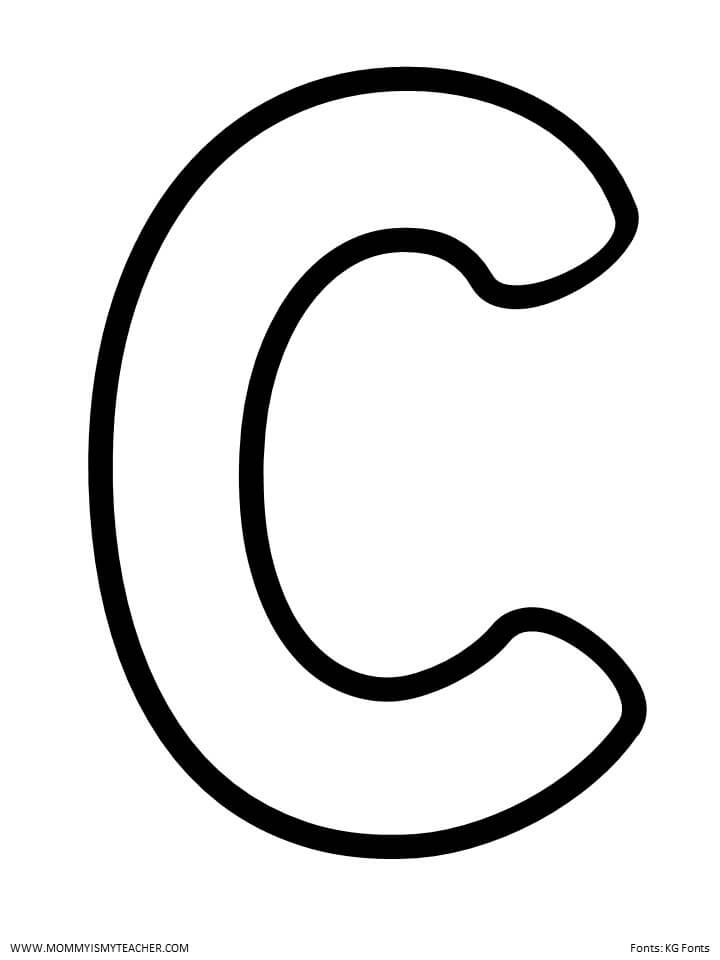
Blank uppercase letter- great for crafts, painting or decorating.

Blank lowercase letter- great for crafts, painting, or decorating.

Letter C Letter Tracing Worksheet
Trace the uppercase letter C.

Lowercase Letter C Tracing Worksheet
Trace the lowercase letter C.

Color the objects that start with the letter.

Letter C Worksheet
Trace and color the letter C printable worksheet.
How to Teach the Letter C
The letter C is a favorite to teach because the shape is simple and the first sound kids learn is easy to hear. Here is how I teach the letter C to preschoolers and kindergarteners, using the free letter C worksheets below.
1. Start with the letter C sound. C has two sounds, but always begin with the hard C, /k/ as in cat. Have your child say "k-k-cat" and feel the sound pop at the back of their throat. Save the soft C, /s/ as in city, for later, once your child is confident with /k/.
2. Teach how to write the letter C. Capital C is one curved line: "start at the top, curve around, stop at the bottom." Lowercase c is the same shape, just smaller. Tell your child to make a "mouth that opens to the right," like a Pac-Man. Practice in the air, in a salt tray, or with finger paint before picking up a pencil.
3. Practice with words that start with C. Use familiar hard C words like cat, cow, cup, car, cake, cookie, corn, and carrot. Have your child "c-c-cook" with pretend food, or sort toy animals and see which ones start with /k/.
4. Watch for common mix-ups. Children often close the curve and write an o, so remind them that C has an opening. C can also be confused with K because both can say /k/. Explain that C is round and K has straight lines. Many kids also draw the letter in the wrong direction, so put a small green dot at the starting point.
Use the letter C tracing worksheets, coloring pages, and beginning sounds worksheets below to practice each step.
Frequently Asked Questions About the Letter C
What age should my child learn the letter C?
Most children begin learning letters between ages 3 and 4. C is an easy letter to trace because it is one curved line, so many children can write it by age 4. There's no need to follow alphabet order, so teach it whenever your child is ready.
What sound does the letter C make?
C makes two sounds. The hard C says /k/ as in cat and cup. The soft C says /s/ as in city and circle. Start with the hard C sound, since it is the most common one at the beginning of words.
What words start with the letter C?
Easy hard C words include cat, cow, cup, car, cake, cookie, corn, camel, and carrot. Soft C words include city, circle, cent, cereal, and celery. For preschoolers, stick with the hard C words first.
What is the difference between hard C and soft C?
A hard C says /k/ and a soft C says /s/. When C comes before e, i, or y, it usually says /s/, as in cent, city, and cycle. Otherwise it usually says /k/. Introduce this rule in kindergarten or first grade, not before.
Why does my child write C backwards?
Reversals are very common in young writers. Show your child where to start (the top), use a green dot as a starting point, and say "curve around" as they write. Practice in sand or shaving cream first, then move to paper. Most children outgrow reversals with steady practice.
What is the easiest way to teach the letter C to a preschooler?
Keep it short and hands-on. Say the /k/ sound, trace the letter in sand or paint, and match it to a few C words like cat and cup. Five to ten minutes a day works better than one long lesson.
Which letter C worksheet should we start with?
Start with tracing to build the curve, then move on to the beginning sounds worksheet. Finish with coloring for a relaxed review. Keep sessions to about 5 to 10 minutes at this age.
