free Letter P Printable Worksheets
All printables for personal or classroom use only.

These letter of the week printables are great for tot school, preschool, and kindergarten children. Children can work on one letter activity each day.


Click on the picture to download the printable.
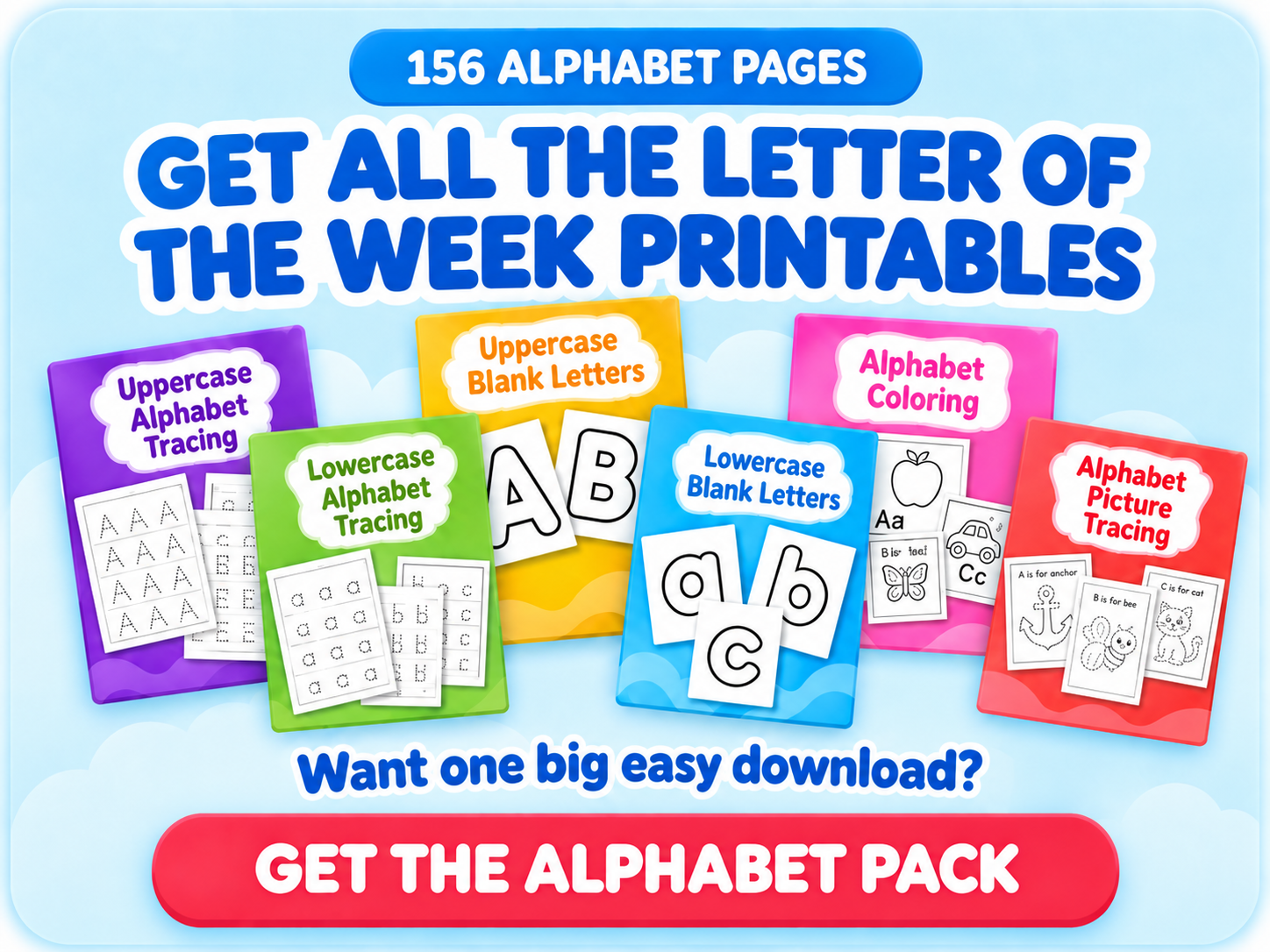
See the entire Letter of the Week curriculum.

Blank uppercase letter- great for crafts, painting or decorating.

Blank lowercase letter- great for crafts, painting, or decorating.

LETTER P UPPERCASE TRACING WORKSHEET-
Trace the uppercase letter P.

LETTER P LOWERCASE TRACING WORKSHEET-
Trace the lowercase letter P.

Color the objects that start with the letter.

Letter P Worksheet
Trace and color the letter P printable worksheet.
How to Teach the Letter P
P is a fun letter to teach because kids can feel the sound pop right out of their mouths. The shape has a tall stick and a bump, so it also gives them good practice with straight lines and curves. Here is how I'd use the letter P worksheets on this page.
1. Start with the popping sound. P says /p/ as in pig. Hold a small strip of paper or a feather in front of your child's lips and have them say "p, p, pop." The paper flutters with each puff of air. The sound is quiet and has no buzz, so try to say /p/ and not "puh."
2. Show how to write it. Capital P is a straight line down, then a bump at the top that curves around and meets the stick in the middle. Lowercase p is a little different, since the stick goes below the bottom line: "down, back up, then bump around." Practice first with big movements, like painting with water on the fence, writing in a tray of rice, or squeezing letters out of toothpaste-sized dabs of paint.
3. Gather P words. A pencil, a pan, a pillow, and a toy penguin are easy to find at home. Pop some popcorn and say "p-p-popcorn" with each kernel, or roll out play dough and press a P into it. More words to try are pig, pie, pizza, pumpkin, puppy, panda, and pear.
4. Watch for lookalikes. Lowercase p is often confused with b, d, and q, since they all use a stick and a bump. For p, the stick hangs below the line and the bump faces right, like a flag. Capital P is sometimes mixed up with R, so mention that R has a leg and P stops at the middle.
The tracing pages, coloring sheets, and beginning sounds worksheets on this page cover each of these steps.
Frequently Asked Questions About the Letter P
When do kids learn the letter P?
Around age 3 to 4 for most children, since the sound is easy and the capital letter is simple to trace. Lowercase p usually takes a little longer because the tail drops below the line. Don't worry if your child needs more time with that part.
What sound does the letter P make?
P makes the /p/ sound, as in pig, pan, and pizza. It is a quick, unvoiced sound made by pressing the lips together and letting out a small puff of air. P has one main sound, which makes it a straightforward letter for beginners.
What words start with the letter P?
A few good starter words are pig, pan, pie, pizza, pumpkin, puppy, penguin, panda, pear, pencil, popcorn, and pillow.Choosing foods and animals your child already likes makes the sound easier to remember.
How can I help my child tell p from b?
Think about where the stick goes. A lowercase p has its stick hanging below the line, and a b has its stick standing up tall. Say "p goes down, b goes up" while tracing them. Writing both on paper with a dotted middle line shows the difference clearly.
What is the difference between the /p/ and /b/ sounds?
Both are made with the lips closed, but /p/ has no voice and /b/ does. Have your child touch their throat and say "p, p, pig," where there's no buzz, then "b, b, bat," where there is. The paper strip works for this too, since /p/ makes it flutter more.
What are some fun ways to practice the letter P at home?
Make popcorn, pretend to be a pirate, play with puppets, or paint with a pom-pom. Even a quick "I spy something that starts with /p/" game in the kitchen is enough to reinforce the sound.
Which letter P worksheets should I try first?
Tracing is a good opening step, since the hanging tail on lowercase p is the part that needs the most repetition. After that, the beginning sounds worksheet checks whether your child can find /p/ in words. Coloring pages are great when you'd like to keep things low-pressure.